 Media Coverage | 20-07-2026
Has the US become badly entangled in the diplomatic trap laid by Russia and China? What might happen next?
The United States appears determined to leave no stone unturned in its effort to bring Iran to heel. Airstrikes continue. Bombs rain down. Iran, for its part, has retaliated. Yet, amid the fog of conflict, the arrival of a highly unusual Russian aircraft on Iranian soil has triggered intense speculation across the globe. The aircraft in question is known as a ‘Doomsday plane’. The term itself evokes visions of catastrophe. It is derived from ‘doomsday’, the day of reckoning, apocalypse or ultimate disaster. Such aircraft are specifically designed for precisely that scenario.
To understand the significance of its appearance in Tehran, one must first understand what a ‘Doomsday plane or aircraft’ actually is. Officially, only the United States, Russia and China are known to possess aircraft of this category, although it is possible that other nations maintain similar capabilities without publicly acknowledging them. These planes serve as airborne command centres in the event of a nuclear war or a catastrophic national emergency. Should a nuclear strike occur, they are designed to evacuate a country’s senior leadership and key officials while simultaneously allowing them to continue directing military operations from the air. Even more remarkably, these aircraft are engineered to withstand the effects of a nuclear attack and remain operational under extreme conditions. Under normal circumstances, such an aircraft can travel approximately 7,000 kilometres. However, its ability to refuel midair greatly extends its operational range, enabling it to remain airborne for prolonged periods and travel long distances. It was against this backdrop that aviation trackers and military observers noticed a highly unusual development. On July 13, Russia’s ‘Doomsday plane’ reportedly landed at Tehran’s Imam Khomeini International Airport. After remaining there for several hours, it departed for Beijing, the capital of China.
The central question now confronting analysts and policymakers alike is simple yet profound: Why did this aircraft, often described as a ‘Flying Kremlin’, travel to Tehran in the first place? Was it dispatched for a high-level security consultation? The question is not without merit. Russia’s ‘Doomsday plane’ is equipped with highly encrypted satellite communications systems and sophisticated electromagnetic shielding capabilities designed to ensure secure communications even in the most hostile environments. Conventional electronic surveillance and intelligence-gathering methods would have little chance of penetrating such a platform. That naturally gives rise to further speculation. Did President Vladimir Putin need to communicate with a particular individual in Tehran under conditions of absolute secrecy? Did the aircraft arrive to transport someone of exceptional importance out of Iran? Or did it bring a key figure into Tehran? These questions have gained additional traction because of reports circulating in diplomatic and intelligence circles that Mojtaba Khamenei, reportedly injured during an American attack, had been moved to Russia for security reasons. Whether there is any connection between those reports and the aircraft’s appearance remains entirely unclear. At present, these remain questions rather than conclusions. Definitive answers are unavailable and much of the discussion is necessarily speculative. Yet, one fact appears difficult to ignore: By sending a ‘Doomsday plane’ to Tehran, Moscow delivered a powerful symbolic message that it stands firmly with Iran.
Last year, Russia and Iran signed a 20-year comprehensive strategic partnership treaty. The two countries have expanded cooperation in intelligence sharing, including the exchange of satellite imagery, operational data and other sensitive information. Iran is also set to receive advanced Russian military hardware, including the S-400 air defence system and sophisticated fighter aircraft. It is entirely possible, though unconfirmed, that some of these capabilities have already been delivered. To be sure, the treaty contains no formal provision obligating Russia to enter a war on Iran’s behalf in the event of an attack. At the same time, it places no restrictions on Moscow choosing to do so should it deem such action necessary. That raises the obvious question: Would Russia intervene directly? In my view, such a step is unlikely. Moscow has little incentive to become openly involved in another major military conflict. However, President Putin continues to keep a close watch on Ukrainian President Volodymyr Zelenskyy. In recent months, Zelenskyy has travelled extensively across the Gulf and secured important defence cooperation agreements with countries such as Saudi Arabia and Qatar. Therefore, it has become necessary for Russia to deal a blow not only to the US but also to the Gulf states through Iran!
China’s cunning move & web of illusion
One important question, however, remains unanswered. If the mission of Russia’s ‘Doomsday plane’ was complete in Tehran, why did it fly to Beijing instead of returning directly to Moscow? Was it carrying a particular individual from Tehran to the Chinese capital? If so, who was that person? And if not, what necessitated a journey to Beijing at all? The aerial distance between Tehran and Moscow is roughly 2,500 kilometres. Yet, instead of taking the direct route home, the aircraft reportedly travelled via Beijing before eventually returning to Russia, a journey covering nearly 11,500 kilometres. It inevitably raises the possibility that something significant was taking place behind the scenes. Equally striking is the US’ silence. This naturally prompts another question: Has the true purpose of the flight remained beyond the reach of American intelligence? Had there been a definitive public assessment, one suspects that President Donald Trump would not have remained silent for long. Trump is not known for diplomatic restraint or strategic ambiguity. He tends to speak his mind openly and rarely conceals his views behind carefully crafted language. By contrast, Vladimir Putin and Xi Jinping do not speak at all!
Sonam Wangchuk & question of politics
Few individuals have contributed as much to innovation in the fields of environmental sustainability and education as Sonam Wangchuk. His pioneering work has offered practical solutions to some of the most pressing challenges posed by climate change in the fragile ecosystem of Ladakh. Through his experiments and initiatives, he has demonstrated how local ingenuity can help communities adapt to rapidly changing environmental conditions. In many ways, his life’s work constitutes a national asset. It was for this reason that, when he embarked on an indefinite hunger strike, a question arose in my mind: Should a person of his stature allow his moral authority and public standing to become instruments in political battles? Many will recall that social activist Anna Hazare also undertook hunger strikes to draw attention to legitimate national concerns. However, the moment he sensed that political forces were attempting to appropriate his movement for their own purposes, he consciously distanced himself. I feel Sonam Wangchuk is needed far more in the realms of environmental protection and educational innovation. I truly pray that he stays healthy, active and full of energy, and that he manages to stay clear of all the petty politics.
The author is the chairman, Editorial Board of Lokmat Media and former member of Rajya Sabha.
vijaydarda@lokmat.com
Intro
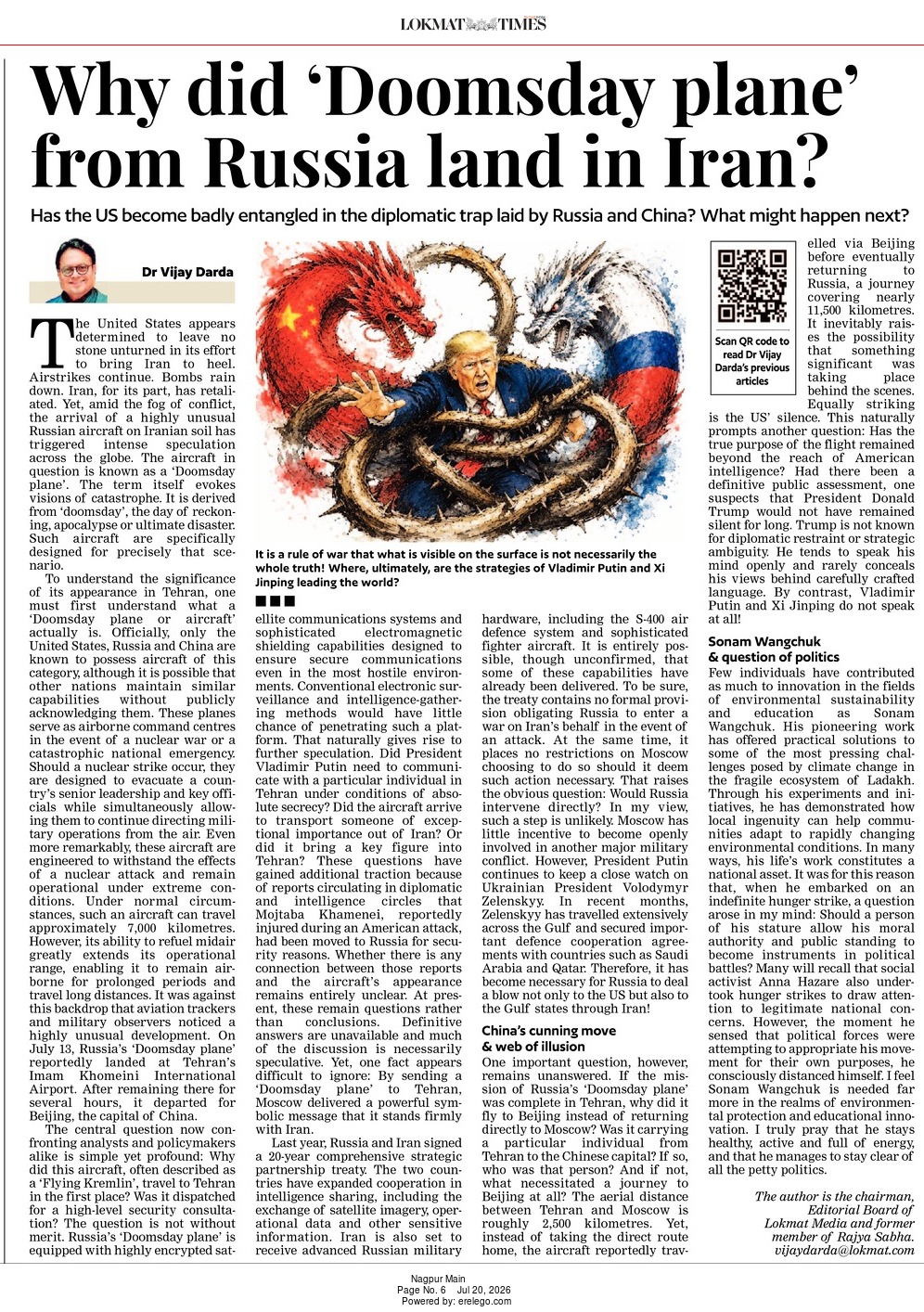
It is a rule of war that what is visible on the surface is not necessarily the whole truth! Where, ultimately, are the strategies of Vladimir Putin and Xi Jinping leading the world?