 Media Coverage | 27-07-2026
Every paper leak is not merely an examination issue but a test of dreams & trust of millions of young people!
The spark lit at Delhi’s Jantar Mantar has finally culminated in the resignation of now former Union education minister Dharmendra Pradhan. Moreover, Prime Minister Narendra Modi announced on Sunday the formation of a high-powered task force, headed by Nandan Nilekani, to reform the education system. I am personally well-acquainted with Nilekani’s sharp intellect. As a member of the parliamentary committee on Aadhaar, I have witnessed his working style firsthand. Nilekani’s appointment could herald a radical transformation of the education system. Should this development be viewed as evidence that policymakers have finally begun to understand the aspirations of the country’s youths? Or is it merely a temporary political response aimed at defusing youths’ anger?
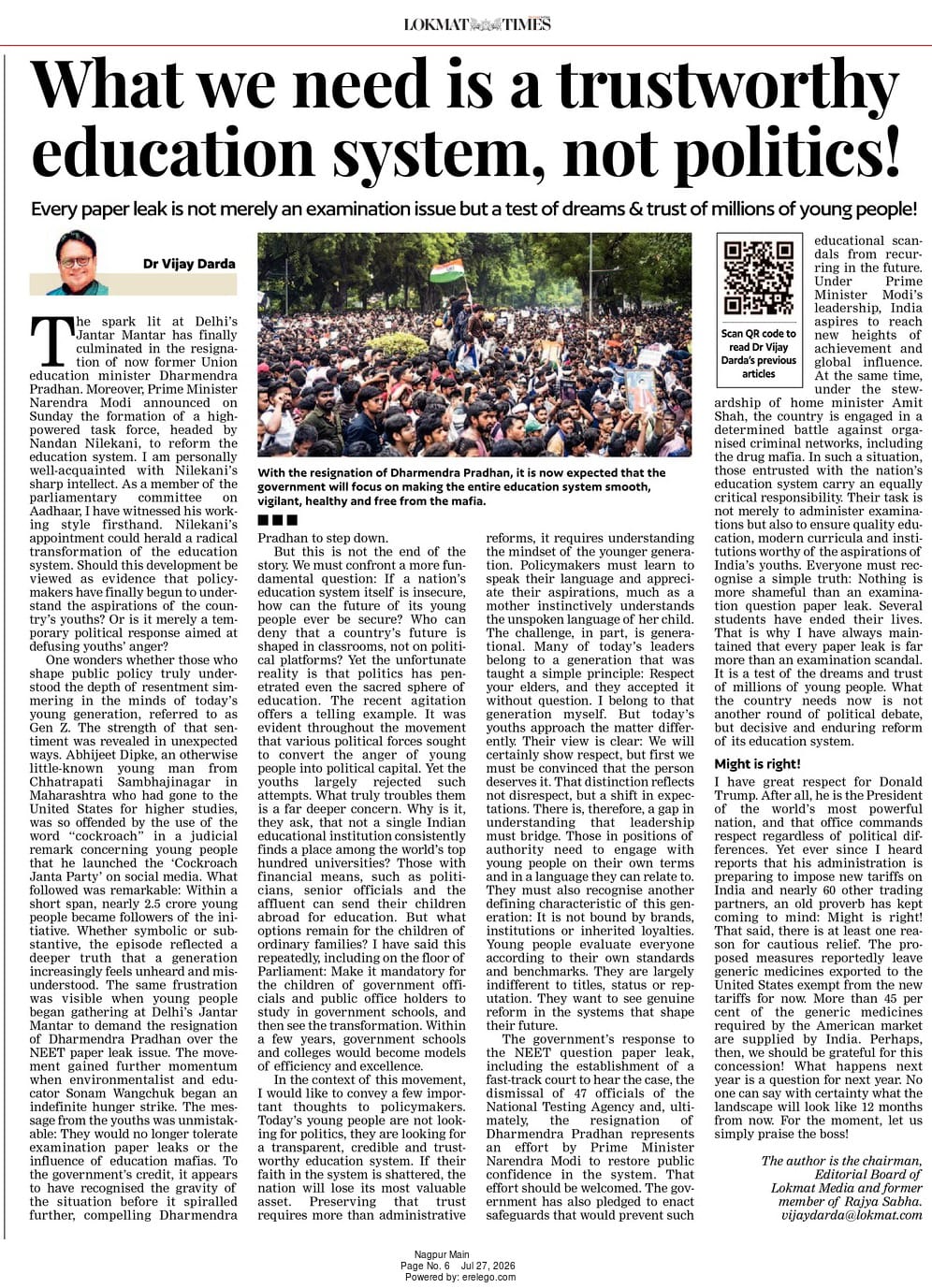
One wonders whether those who shape public policy truly understood the depth of resentment simmering in the minds of today’s young generation, referred to as Gen Z. The strength of that sentiment was revealed in unexpected ways. Abhijeet Dipke, an otherwise little-known young man from Chhatrapati Sambhajinagar in Maharashtra who had gone to the United States for higher studies, was so offended by the use of the word “cockroach” in a judicial remark concerning young people that he launched the ‘Cockroach Janta Party’ on social media. What followed was remarkable: Within a short span, nearly 2.5 crore young people became followers of the initiative. Whether symbolic or substantive, the episode reflected a deeper truth that a generation increasingly feels unheard and misunderstood. The same frustration was visible when young people began gathering at Delhi’s Jantar Mantar to demand the resignation of Dharmendra Pradhan over the NEET paper leak issue. The movement gained further momentum when environmentalist and educator Sonam Wangchuk began an indefinite hunger strike. The message from the youths was unmistakable: They would no longer tolerate examination paper leaks or the influence of education mafias. To the government’s credit, it appears to have recognised the gravity of the situation before it spiralled further, compelling Dharmendra Pradhan to step down.
But this is not the end of the story. We must confront a more fundamental question: If a nation’s education system itself is insecure, how can the future of its young people ever be secure? Who can deny that a country’s future is shaped in classrooms, not on political platforms? Yet the unfortunate reality is that politics has penetrated even the sacred sphere of education. The recent agitation offers a telling example. It was evident throughout the movement that various political forces sought to convert the anger of young people into political capital. Yet the youths largely rejected such attempts. What truly troubles them is a far deeper concern. Why is it, they ask, that not a single Indian educational institution consistently finds a place among the world’s top hundred universities? Those with financial means, such as politicians, senior officials and the affluent can send their children abroad for education. But what options remain for the children of ordinary families? I have said this repeatedly, including on the floor of Parliament: Make it mandatory for the children of government officials and public office holders to study in government schools, and then see the transformation. Within a few years, government schools and colleges would become models of efficiency and excellence.
In the context of this movement, I would like to convey a few important thoughts to policymakers. Today’s young people are not looking for politics, they are looking for a transparent, credible and trustworthy education system. If their faith in the system is shattered, the nation will lose its most valuable asset. Preserving that trust requires more than administrative reforms, it requires understanding the mindset of the younger generation. Policymakers must learn to speak their language and appreciate their aspirations, much as a mother instinctively understands the unspoken language of her child. The challenge, in part, is generational. Many of today’s leaders belong to a generation that was taught a simple principle: Respect your elders, and they accepted it without question. I belong to that generation myself. But today’s youths approach the matter differently. Their view is clear: We will certainly show respect, but first we must be convinced that the person deserves it. That distinction reflects not disrespect, but a shift in expectations. There is, therefore, a gap in understanding that leadership must bridge. Those in positions of authority need to engage with young people on their own terms and in a language they can relate to. They must also recognise another defining characteristic of this generation: It is not bound by brands, institutions or inherited loyalties. Young people evaluate everyone according to their own standards and benchmarks. They are largely indifferent to titles, status or reputation. They want to see genuine reform in the systems that shape their future.
The government’s response to the NEET question paper leak, including the establishment of a fast-track court to hear the case, the dismissal of 47 officials of the National Testing Agency and, ultimately, the resignation of Dharmendra Pradhan represents an effort by Prime Minister Narendra Modi to restore public confidence in the system. That effort should be welcomed. The government has also pledged to enact safeguards that would prevent such educational scandals from recurring in the future. Under Prime Minister Modi’s leadership, India aspires to reach new heights of achievement and global influence. At the same time, under the stewardship of home minister Amit Shah, the country is engaged in a determined battle against organised criminal networks, including the drug mafia. In such a situation, those entrusted with the nation’s education system carry an equally critical responsibility. Their task is not merely to administer examinations but also to ensure quality education, modern curricula and institutions worthy of the aspirations of India’s youths. Everyone must recognise a simple truth: Nothing is more shameful than an examination question paper leak. Several students have ended their lives. That is why I have always maintained that every paper leak is far more than an examination scandal. It is a test of the dreams and trust of millions of young people. What the country needs now is not another round of political debate, but decisive and enduring reform of its education system.
Might is right!
I have great respect for Donald Trump. After all, he is the President of the world’s most powerful nation, and that office commands respect regardless of political differences. Yet ever since I heard reports that his administration is preparing to impose new tariffs on India and nearly 60 other trading partners, an old proverb has kept coming to mind: Might is right! That said, there is at least one reason for cautious relief. The proposed measures reportedly leave generic medicines exported to the United States exempt from the new tariffs for now. More than 45 per cent of the generic medicines required by the American market are supplied by India. Perhaps, then, we should be grateful for this concession! What happens next year is a question for next year. No one can say with certainty what the landscape will look like 12 months from now. For the moment, let us simply praise the boss!
The author is the chairman, Editorial Board of Lokmat Media and former member of Rajya Sabha.
vijaydarda@lokmat.com