 Media Coverage | 03-08-2026
Living in abject poverty, PoK is seething with anger; the prosperity of Indian Kashmir beckons it
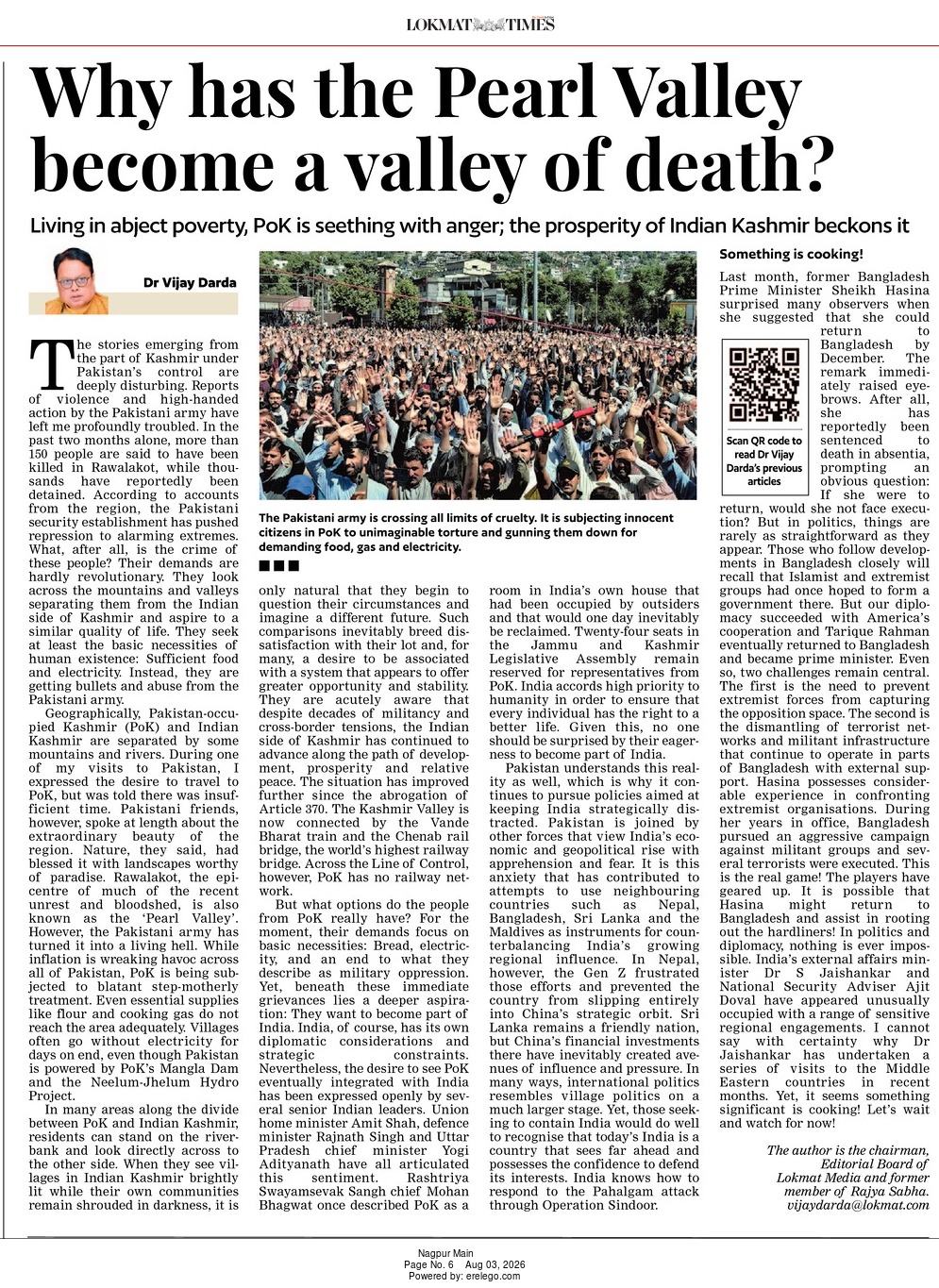
The stories emerging from the part of Kashmir under Pakistan’s control are deeply disturbing. Reports of violence and high-handed action by the Pakistani army have left me profoundly troubled. In the past two months alone, more than 150 people are said to have been killed in Rawalakot, while thousands have reportedly been detained. According to accounts from the region, the Pakistani security establishment has pushed repression to alarming extremes. What, after all, is the crime of these people? Their demands are hardly revolutionary. They look across the mountains to the Indian side of Kashmir and aspire to a similar quality of life. They seek at the least the basic necessities of human existence: Sufficient food and electricity. Instead, they are getting bullets and abuse from the Pakistani army.
Geographically, Pakistan-occupied Kashmir (PoK) and Indian Kashmir are separated by some mountains and rivers. During one of my visits to Pakistan, I expressed the desire to travel to PoK, but was told there was insufficient time. Pakistani friends, however, spoke at length about the extraordinary beauty of the region. Nature, they said, had blessed it with landscapes worthy of paradise. Rawalakot, the epicentre of much of the recent unrest and bloodshed, is also known as the ‘Pearl Valley’. However, the Pakistani Army has turned it into a living hell. While inflation is wreaking havoc across all of Pakistan, PoK is being subjected to blatant step-motherly treatment. Even essential supplies like flour and cooking gas do not reach the area adequately. Villages often go without electricity for days on end, even though Pakistan is powered by PoK’s Mangla Dam and the Neelum-Jhelum Hydro Project.
In many areas along the divide between PoK and Indian Kashmir, residents can stand on the riverbank and look directly across to the other side. When they see villages in Indian Kashmir brightly lit while their own communities remain shrouded in darkness, it is only natural that they begin to question their circumstances and imagine a different future. Such comparisons inevitably breed dissatisfaction with their lot and, for many, a desire to be associated with a system that appears to offer greater opportunity and stability. They are acutely aware that despite decades of militancy and cross-border tensions, the Indian side of Kashmir has continued to advance along the path of development, prosperity and relative peace. The situation has improved further since the abrogation of Article 370. The Kashmir Valley is now connected by the Vande Bharat train and the Chenab rail bridge, the world’s highest railway bridge. Across the Line of Control, however, PoK has no railway network.
But what options do the people from PoK really have? For the moment, their demands focus on basic necessities: Bread, electricity, and an end to what they describe as military oppression. Yet, beneath these immediate grievances lies a deeper aspiration: They want to become part of India. India, of course, has its own diplomatic considerations and strategic constraints. Nevertheless, the desire to see PoK eventually integrated with India has been expressed openly by several senior Indian leaders. Union home minister Amit Shah, defence minister Rajnath Singh and Uttar Pradesh chief minister Yogi Adityanath have all articulated this sentiment. Rashtriya Swayamsevak Sangh chief Mohan Bhagwat once described PoK as a room in India’s own house that had been occupied by outsiders and that would one day inevitably be reclaimed. Twenty-four seats in the Jammu and Kashmir Legislative Assembly remain reserved for representatives from PoK. India accords high priority to humanity in order to ensure that every individual has the right to a better life. Given this, no one should be surprised by their eagerness to become part of India.
Pakistan understands this reality as well, which is why it continues to pursue policies aimed at keeping India strategically distracted. Pakistan is joined by other forces that view India’s economic and geopolitical rise with apprehension and fear. It is this anxiety that has contributed to attempts to use neighbouring countries such as Nepal, Bangladesh, Sri Lanka and the Maldives as instruments for counterbalancing India’s growing regional influence. In Nepal, however, the Gen Z frustrated those efforts and prevented the country from slipping entirely into China’s strategic orbit. Sri Lanka remains a friendly nation, but China’s financial investments there have inevitably created avenues of influence and pressure. In many ways, international politics resembles village politics on a much larger stage. Yet, those seeking to contain India would do well to recognise that today’s India is a country that sees far ahead and possesses the confidence to defend its interests. India knows how to respond to the Pakistani attack through Operation Sindoor.
Something is cooking !
Last month, former Bangladesh Prime Minister Sheikh Hasina surprised many observers when she suggested that she could return to Bangladesh by December. The remark immediately raised eyebrows. After all, she has reportedly been sentenced to death in absentia, prompting an obvious question: If she were to return, would she not face execution? But in politics, things are rarely as straightforward as they appear. Those who follow developments in Bangladesh closely will recall that Islamist and extremist groups had once hoped to form a government there. But that diplomacy succeeded with America’s cooperation and Tarique Rahman eventually returned to Bangladesh and became prime minister. Even so, two challenges remain central. The first is the need to prevent extremist forces from controlling the opposition space. The second is the dismantling of terrorist networks and militant infrastructure that continue to operate in parts of Bangladesh with external support. Hasina possesses considerable experience in confronting extremist organisations. During her years in office, Bangladesh pursued an aggressive campaign against militant groups and several terrorists were executed. This is the real game! The players have geared up. It is possible that Hasina might return to Bangladesh and assist in rooting out the hardliners! In politics and diplomacy, nothing is ever impossible. India’s external affairs minister Dr S Jaishankar and National Security Adviser Ajit Doval have appeared unusually occupied with a range of sensitive regional engagements. I cannot say with certainty why Dr Jaishankar has undertaken a series of visits to the Middle Eastern countries in recent months. Yes, it seems that something significant is cooking! Let’s wait and watch for now !