 Media Coverage | 10-08-2026
Everyone agrees with the RSS chief that Gen Z should be made to feel a sense of belonging
You must have heard the famous song penned by poet and lyricist Pradeep: ‘Hum laaye hain toofaan se kashti nikaal ke, is desh ko rakhnaa mere bachchon sambhaal ke.’ The message could not be clearer: The future belongs to the next generation. Their perspective and mindset are the yardstick for our future. It is for this reason that I completely agree with the Rashtriya Swayamsevak Sangh chief Mohan Bhagwat that Gen Z’s protests are not anti-national. They are our own. They are our next generation. What they need is not only dialogue but also a sense of belonging.
I wrote in this column in the last week of July that today’s young Indians are looking for a transparent and trustworthy education system, not politics. If the trust of the youths is lost, the country will lose its most valuable asset. And if that trust is to be preserved, we must learn to understand their language, their anxieties and their aspirations much as a mother instinctively understands the unspoken language of her child. Most of today’s leaders belong to a generation that was taught to respect their elders, and they accepted it unquestioningly. I belong to that generation myself. But today’s youths say: “We will certainly show respect but first we must be convinced that the person concerned deserves it!” The leaders must learn to communicate with today’s youths in their own language and understand that they are not tied to any particular brand.
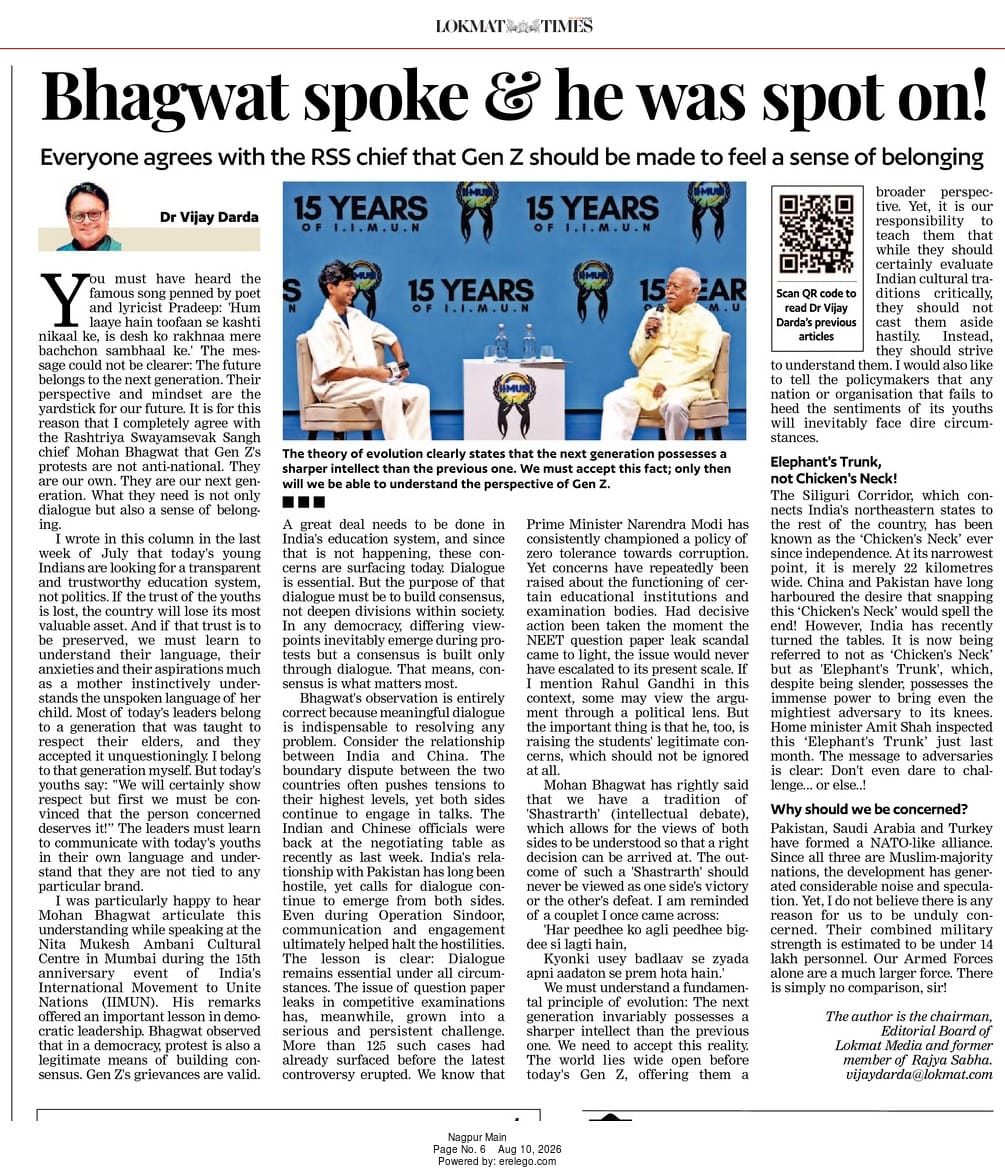
I was particularly happy to hear Mohan Bhagwat articulate this understanding while speaking at the Nita Mukesh Ambani Cultural Centre in Mumbai during the 15th anniversary event of India’s International Movement to Unite Nations (IIMUN). His remarks offered an important lesson in democratic leadership. Bhagwat observed that in a democracy, protest is also a legitimate means of building consensus. Gen Z’s grievances are valid. A great deal needs to be done in India’s education system, and since that is not happening, these concerns are surfacing today. Dialogue is essential. But the purpose of that dialogue must be to build consensus, not deepen divisions within society. In any democracy, differing viewpoints inevitably emerge during protests but a consensus is built only through dialogue. That means, consensus is what matters most.
Bhagwat’s observation is entirely correct because meaningful dialogue is indispensable to resolving any problem. Consider the relationship between India and China. The boundary dispute between the two countries often pushes tensions to their highest levels, yet both sides continue to engage in talks. The Indian and Chinese officials were back at the negotiating table as recently as last week. India’s relationship with Pakistan has long been hostile, yet calls for dialogue continue to emerge from both sides. Even during Operation Sindoor, communication and engagement ultimately helped halt the hostilities. The lesson is clear: Dialogue remains essential under all circumstances. The issue of question paper leaks in competitive examinations has, meanwhile, grown into a serious and persistent challenge. More than 125 such cases had already surfaced before the latest controversy erupted. We know that Prime Minister Narendra Modi has consistently championed a policy of zero tolerance towards corruption. Yet concerns have repeatedly been raised about the functioning of certain educational institutions and examination bodies. Had decisive action been taken the moment the NEET question paper leak scandal came to light, the issue would never have escalated to its present scale. If I mention Rahul Gandhi in this context, some may view the argument through a political lens. But the important thing is that he, too, is raising the students’ legitimate concerns, which should not be ignored at all.
Mohan Bhagwat has rightly said that we have a tradition of ‘Shastrarth’ (intellectual debate), which allows for the views of both sides to be understood so that a right decision can be arrived at. The outcome of such a ‘Shastrarth’ should never be viewed as one side’s victory or the other’s defeat. I am reminded of a couplet I once came across:
‘Har peedhee ko agli peedhee bigdee si lagti hain,
Kyonki usey badlaav se zyada apni aadaton se prem hota hain.’
We must understand a fundamental principle of evolution: The next generation invariably possesses a sharper intellect than the previous one. We need to accept this reality. The world lies wide open before today’s Gen Z, offering them a broader perspective. Yet, it is our responsibility to teach them that while they should certainly evaluate Indian cultural traditions critically, they should not cast them aside hastily. Instead, they should strive to understand them. I would also like to tell the policymakers that any nation or organisation that fails to heed the sentiments of its youths will inevitably face dire circumstances.
Elephant’s Trunk, not Chicken’s Neck!
The Siliguri Corridor, which connects India’s northeastern states to the rest of the country, has been known as the ‘Chicken’s Neck’ ever since independence. At its narrowest point, it is merely 22 kilometres wide. China and Pakistan have long harboured the desire that snapping this ‘Chicken’s Neck’ would spell the end! However, India has recently turned the tables. It is now being referred to not as ‘Chicken’s Neck’ but as ‘Elephant’s Trunk’, which, despite being slender, possesses the immense power to bring even the mightiest adversary to its knees. Home minister Amit Shah inspected this ‘Elephant’s Trunk’ just last month. The message to adversaries is clear: Don’t even dare to challenge… or else..!
Why should we be concerned?
Pakistan, Saudi Arabia and Turkey have formed a NATO-like alliance. Since all three are Muslim-majority nations, the development has generated considerable noise and speculation. Yet, I do not believe there is any reason for us to be unduly concerned. Their combined military strength is estimated to be under 14 lakh personnel. Our Armed Forces alone are a much larger force. There is simply no comparison, sir!
The author is the chairman, Editorial Board of Lokmat Media and former member of Rajya Sabha.