 Media Coverage | 21-09-2026
Where did the natives of this island, defined by the resonance of Indian culture and religious tolerance, eventually go?
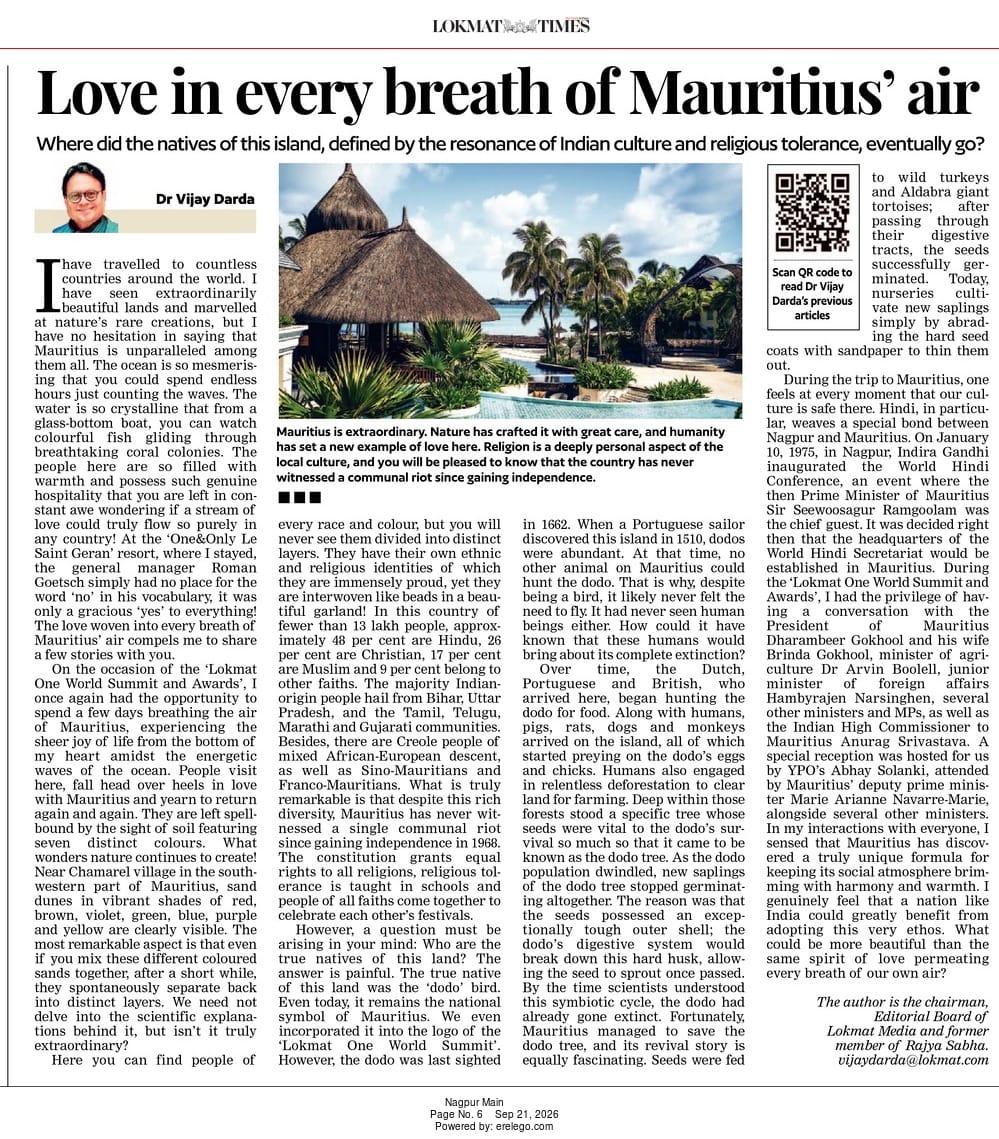
I have travelled to countless countries around the world. I have seen extraordinarily beautiful lands and marvelled at nature’s rare creations, but I have no hesitation in saying that Mauritius is unparalleled among them all. The ocean is so mesmerising that you could spend endless hours just counting the waves. The water is so crystalline that from a glass-bottom boat, you can watch colourful fish gliding through breathtaking coral colonies. The people here are so filled with warmth and possess such genuine hospitality that you are left in constant awe wondering if a stream of love could truly flow so purely in any country! At the ‘One&Only Le Saint Geran’ resort, where I stayed, the general manager Roman Goetsch simply had no place for the word ‘no’ in his vocabulary, it was only a gracious ‘yes’ to everything! The love woven into every breath of Mauritius’ air compels me to share a few stories with you.
On the occasion of the ‘Lokmat One World Summit and Awards’, I once again had the opportunity to spend a few days breathing the air of Mauritius, experiencing the sheer joy of life from the bottom of my heart amidst the energetic waves of the ocean. People visit here, fall head over heels in love with Mauritius and yearn to return again and again. They are left spellbound by the sight of soil featuring seven distinct colours. What wonders nature continues to create! Near Chamarel village in the southwestern part of Mauritius, sand dunes in vibrant shades of red, brown, violet, green, blue, purple and yellow are clearly visible. The most remarkable aspect is that even if you mix these different coloured sands together, after a short while, they spontaneously separate back into distinct layers. We need not delve into the scientific explanations behind it, but isn’t it truly extraordinary?
Here you can find people of every race and colour, but you will never see them divided into distinct layers. They have their own ethnic and religious identities of which they are immensely proud, yet they are interwoven like beads in a beautiful garland! In this country of fewer than 13 lakh people, approximately 48 per cent are Hindu, 26 per cent are Christian, 17 per cent are Muslim and 9 per cent belong to other faiths. The majority Indian-origin people hail from Bihar, Uttar Pradesh, and the Tamil, Telugu, Marathi and Gujarati communities. Besides, there are Creole people of mixed African-European descent, as well as Sino-Mauritians and Franco-Mauritians. What is truly remarkable is that despite this rich diversity, Mauritius has never witnessed a single communal riot since gaining independence in 1968. The constitution grants equal rights to all religions, religious tolerance is taught in schools and people of all faiths come together to celebrate each other’s festivals.
However, a question must be arising in your mind: Who are the true natives of this land? The answer is painful. The true native of this land was the ‘dodo’ bird. Even today, it remains the national symbol of Mauritius. We even incorporated it into the logo of the ‘Lokmat One World Summit’. However, the dodo was last sighted in 1662. When a Portuguese sailor discovered this island in 1510, dodos were abundant. At that time, no other animal on Mauritius could hunt the dodo. That is why, despite being a bird, it likely never felt the need to fly. It had never seen human beings either. How could it have known that these humans would bring about its complete extinction?
Over time, the Dutch, Portuguese and British, who arrived here, began hunting the dodo for food. Along with humans, pigs, rats, dogs and monkeys arrived on the island, all of which started preying on the dodo’s eggs and chicks. Humans also engaged in relentless deforestation to clear land for farming. Deep within those forests stood a specific tree whose seeds were vital to the dodo’s survival so much so that it came to be known as the dodo tree. As the dodo population dwindled, new saplings of the dodo tree stopped germinating altogether. The reason was that the seeds possessed an exceptionally tough outer shell; the dodo’s digestive system would break down this hard husk, allowing the seed to sprout once passed. By the time scientists understood this symbiotic cycle, the dodo had already gone extinct. Fortunately, Mauritius managed to save the dodo tree, and its revival story is equally fascinating. Seeds were fed to wild turkeys and Aldabra giant tortoises; after passing through their digestive tracts, the seeds successfully germinated. Today, nurseries cultivate new saplings simply by abrading the hard seed coats with sandpaper to thin them out.
During the trip to Mauritius, one feels at every moment that our culture is safe there. Hindi, in particular, weaves a special bond between Nagpur and Mauritius. On January 10, 1975, in Nagpur, Indira Gandhi inaugurated the World Hindi Conference, an event where the then Prime Minister of Mauritius Sir Seewoosagur Ramgoolam was the chief guest. It was decided right then that the headquarters of the World Hindi Secretariat would be established in Mauritius. During the ‘Lokmat One World Summit and Awards’, I had the privilege of having a conversation with the President of Mauritius Dharambeer Gokhool and his wife Brinda Gokhool, minister of agriculture Dr Arvin Boolell, junior minister of foreign affairs Hambyrajen Narsinghen, several other ministers and MPs, as well as the Indian High Commissioner to Mauritius Anurag Srivastava. A special reception was hosted for us by YPO’s Abhay Solanki, attended by Mauritius’ deputy prime minister Marie Arianne Navarre-Marie, alongside several other ministers. In my interactions with everyone, I sensed that Mauritius has discovered a truly unique formula for keeping its social atmosphere brimming with harmony and warmth. I genuinely feel that a nation like India could greatly benefit from adopting this very ethos. What could be more beautiful than the same spirit of love permeating every breath of our own air?
The author is the chairman, Editorial Board of Lokmat Media and former member of Rajya Sabha.