 Media Coverage | 05-10-2026
EC is a constitutional body; it is only natural for the nation to be concerned if questions are raised against it
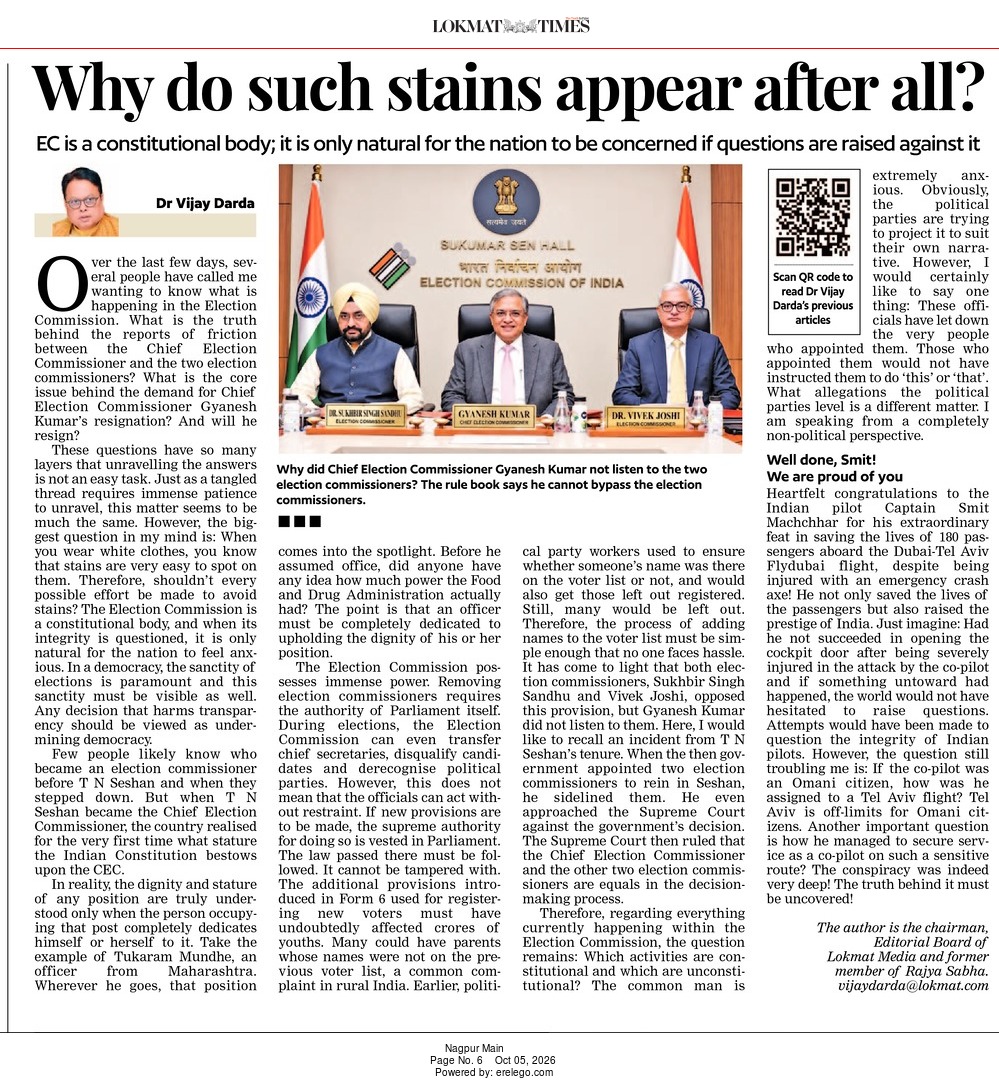
Over the last few days, several people have called me wanting to know what is happening in the Election Commission. What is the truth behind the reports of friction between the Chief Election Commissioner and the two election commissioners? What is the core issue behind the demand for Chief Election Commissioner Gyanesh Kumar’s resignation? And will he resign?
These questions have so many layers that unravelling the answers is not an easy task. Just as a tangled thread requires immense patience to unravel, this matter seems to be much the same. However, the biggest question in my mind is: When you wear white clothes, you know that stains are very easy to spot on them. Therefore, shouldn’t every possible effort be made to avoid stains? The Election Commission is a constitutional body, and when its integrity is questioned, it is only natural for the nation to feel anxious. In a democracy, the sanctity of elections is paramount and this sanctity must be visible as well. Any decision that harms transparency should be viewed as undermining democracy.
Few people likely know who became an election commissioner before T N Seshan and when they stepped down. But when T N Seshan became the Chief Election Commissioner, the country realised for the very first time what stature the Indian Constitution bestows upon the CEC.
In reality, the dignity and stature of any position are truly understood only when the person occupying that post completely dedicates himself or herself to it. Take the example of Tukaram Mundhe, an officer from Maharashtra. Wherever he goes, that position comes into the spotlight. Before he assumed office, did anyone have any idea how much power the Food and Drug Administration actually had? The point is that an officer must be completely dedicated to upholding the dignity of his or her position.
The Election Commission possesses immense power. Removing election commissioners requires the authority of Parliament itself. During elections, the Election Commission can even transfer chief secretaries, disqualify candidates and derecognise political parties. However, this does not mean that the officials can act without restraint. If new provisions are to be made, the supreme authority for doing so is vested in Parliament. The law passed there must be followed. It cannot be tampered with. The additional provisions introduced in Form 6 used for registering new voters must have undoubtedly affected crores of youths. Many could have parents whose names were not on the previous voter list, a common complaint in rural India. Earlier, political party workers used to ensure whether someone’s name was there on the voter list or not, and would also get those left out registered. Still, many would be left out. Therefore, the process of adding names to the voter list must be simple enough that no one faces hassle. It has come to light that both election commissioners, Sukhbir Singh Sandhu and Vivek Joshi, opposed this provision, but Gyanesh Kumar did not listen to them. Here, I would like to recall an incident from T N Seshan’s tenure. When the then government appointed two election commissioners to rein in Seshan, he sidelined them. He even approached the Supreme Court against the government’s decision. The Supreme Court then ruled that the Chief Election Commissioner and the other two election commissioners are equals in the decision-making process.
Therefore, regarding everything currently happening within the Election Commission, the question remains: Which activities are constitutional and which are unconstitutional? The common man is extremely anxious. Obviously, the political parties are trying to project it to suit their own narrative. However, I would certainly like to say one thing: These officials have let down the very people who appointed them. Those who appointed them would not have instructed them to do ‘this’ or ‘that’. What allegations the political parties level is a different matter. I am speaking from a completely non-political perspective.
Well done, Smit! We are proud of you
Heartfelt congratulations to the Indian pilot Captain Smit Machchhar for his extraordinary feat in saving the lives of 180 passengers aboard the Dubai-Tel Aviv Flydubai flight, despite being injured with an emergency crash axe! He not only saved the lives of the passengers but also raised the prestige of India. Just imagine: Had he not succeeded in opening the cockpit door after being severely injured in the attack by the co-pilot and if something untoward had happened, the world would not have hesitated to raise questions. Attempts would have been made to question the integrity of Indian pilots. However, the question still troubling me is: If the co-pilot was an Omani citizen, how was he assigned to a Tel Aviv flight? Tel Aviv is off-limits for Omani citizens. Another important question is how he managed to secure service as a co-pilot on such a sensitive route? The conspiracy was indeed very deep! The truth behind it must be uncovered!
The author is the chairman, Editorial Board of Lokmat Media and former member of Rajya Sabha.