 Media Coverage | 13-07-2026
Pakistanis are making empty threats of war over water; they ought to remember the wars of the past!
India last week opened three gates of the Baglihar Dam on the Chenab River in Jammu and Kashmir’s Ramban district, allowing water to flow downstream into Pakistan. The reaction across the border was immediate and intense. Until recently, Pakistan had been protesting that India was withholding water. Now that water has been released, voices ranging from military officials to political leaders have adopted an increasingly belligerent tone. Among the most vocal has been Bilawal Bhutto Zardari, chairman of the Pakistan People’s Party, who has spoken openly in the language of confrontation and conflict. In doing so, he appears to have forgotten the events of 1971, when more than 90,000 Pakistani soldiers surrendered to the Indian Army.
For decades, analysts have warned that future conflicts could be fought over water, often invoking the spectre of a ‘Third World War’. In Pakistan’s case, however, the rhetoric has moved beyond metaphor. War is being discussed not as a distant possibility but as a political talking point. The dispute stems from the Indus Waters Treaty of 1960, which has governed the sharing of river waters between India and Pakistan for more than six decades. Under the treaty, India enjoys full rights over the waters of the Ravi, Sutlej and Beas rivers, while Pakistan receives the waters of the Jhelum, Indus and Chenab rivers. Historically, whenever water levels in these rivers rose significantly, India would provide advance flood warnings to Pakistan. Following last year’s terrorist attack in Pahalgam, however, New Delhi declared that ‘blood and water cannot flow together’. India subsequently held the waters treaty in abeyance. As a result, it no longer considers itself obligated to share river-related information with Pakistan. That is why no advance notice was reportedly given before water was released from the Baglihar Dam.
Nearly 90 per cent of Pakistan’s agriculture depends on the Indus river system. The country lacks sufficient reservoir capacity to store and manage water supplies effectively during periods of scarcity. Consequently, the country faced serious problems during summer. Pakistan has appealed to the international forums and is writing to the United Nations, seeking diplomatic support abroad. India, however, has remained firm in its position: End terrorism; only then will talks take place. Faced with this impasse, Pakistan has increasingly resorted to issuing threats. Soon after India suspended the Indus Waters Treaty, Pakistan’s National Security Council declared in a meeting that any attempt to block or divert water would be treated as an act of war. More recently, a Corps Commanders’ Conference chaired by General Asim Munir reiterated that the Pakistani military would defend what it considers its legitimate rights. Pakistani foreign minister Ishaq Dar, too, had stated that any attempt to block water would be viewed as a hostile action. In other words, everyone is speaking the language of war.
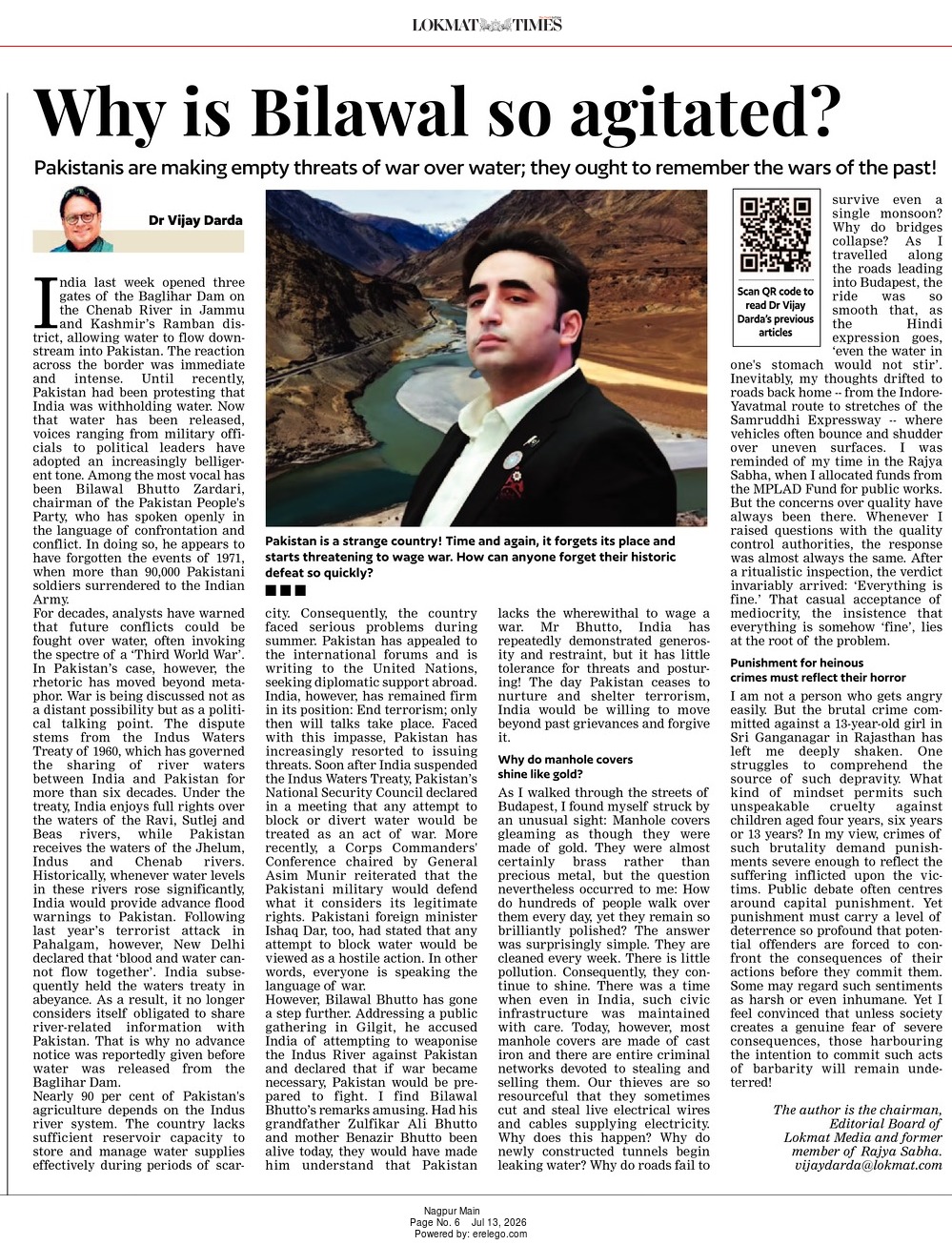
However, Bilawal Bhutto has gone a step further. Addressing a public gathering in Gilgit, he accused India of attempting to weaponise the Indus River against Pakistan and declared that if war became necessary, Pakistan would be prepared to fight. I find Bilawal Bhutto’s remarks amusing. Had his grandfather Zulfikar Ali Bhutto and mother Benazir Bhutto been alive today, they would have made him understand that Pakistan lacks the wherewithal to wage a war. Mr Bhutto, India has repeatedly demonstrated generosity and restraint, but it has little tolerance for threats and posturing! The day Pakistan ceases to nurture and shelter terrorism, India would be willing to move beyond past grievances and forgive it.
Why do manhole covers
shine like gold?
As I walked through the streets of Budapest, I found myself struck by an unusual sight: Manhole covers gleaming as though they were made of gold. They were almost certainly brass rather than precious metal, but the question nevertheless occurred to me: How do hundreds of people walk over them every day, yet they remain so brilliantly polished? The answer was surprisingly simple. They are cleaned every week. There is little pollution. Consequently, they continue to shine. There was a time when even in India, such civic infrastructure was maintained with care. Today, however, most manhole covers are made of cast iron and there are entire criminal networks devoted to stealing and selling them. Our thieves are so resourceful that they sometimes cut and steal live electrical wires and cables supplying electricity. Why does this happen? Why do newly constructed tunnels begin leaking water? Why do roads fail to survive even a single monsoon? Why do bridges collapse? As I travelled along the roads leading into Budapest, the ride was so smooth that, as the Hindi expression goes, ‘even the water in one’s stomach would not stir’. Inevitably, my thoughts drifted to roads back home — from the Indore-Yavatmal route to stretches of the Samruddhi Expressway — where vehicles often bounce and shudder over uneven surfaces. I was reminded of my time in the Rajya Sabha, when I allocated funds from the MPLAD Fund for public works. But the concerns over quality have always been there. Whenever I raised questions with the quality control authorities, the response was almost always the same. After a ritualistic inspection, the verdict invariably arrived: ‘Everything is fine.’ That casual acceptance of mediocrity, the insistence that everything is somehow ‘fine’, lies at the root of the problem.
Punishment for heinous
crimes must reflect their horror
I am not a person who gets angry easily. But the brutal crime committed against a 13-year-old girl in Sri Ganganagar in Rajasthan has left me deeply shaken. One struggles to comprehend the source of such depravity. What kind of mindset permits such unspeakable cruelty against children aged four years, six years or 13 years? In my view, crimes of such brutality demand punishments severe enough to reflect the suffering inflicted upon the victims. Public debate often centres around capital punishment. Yet punishment must carry a level of deterrence so profound that potential offenders are forced to confront the consequences of their actions before they commit them. Some may regard such sentiments as harsh or even inhumane. Yet I feel convinced that unless society creates a genuine fear of severe consequences, those harbouring the intention to commit such acts of barbarity will remain undeterred!
Pakistan is a strange country! Time and again, it forgets its place and starts threatening to wage war. How can anyone forget their historic defeat so quickly?