 Media Coverage | 06-07-2026
Who will untie these knots? You may write a hundred thousand letters… will the Pakistani army & ISI listen?
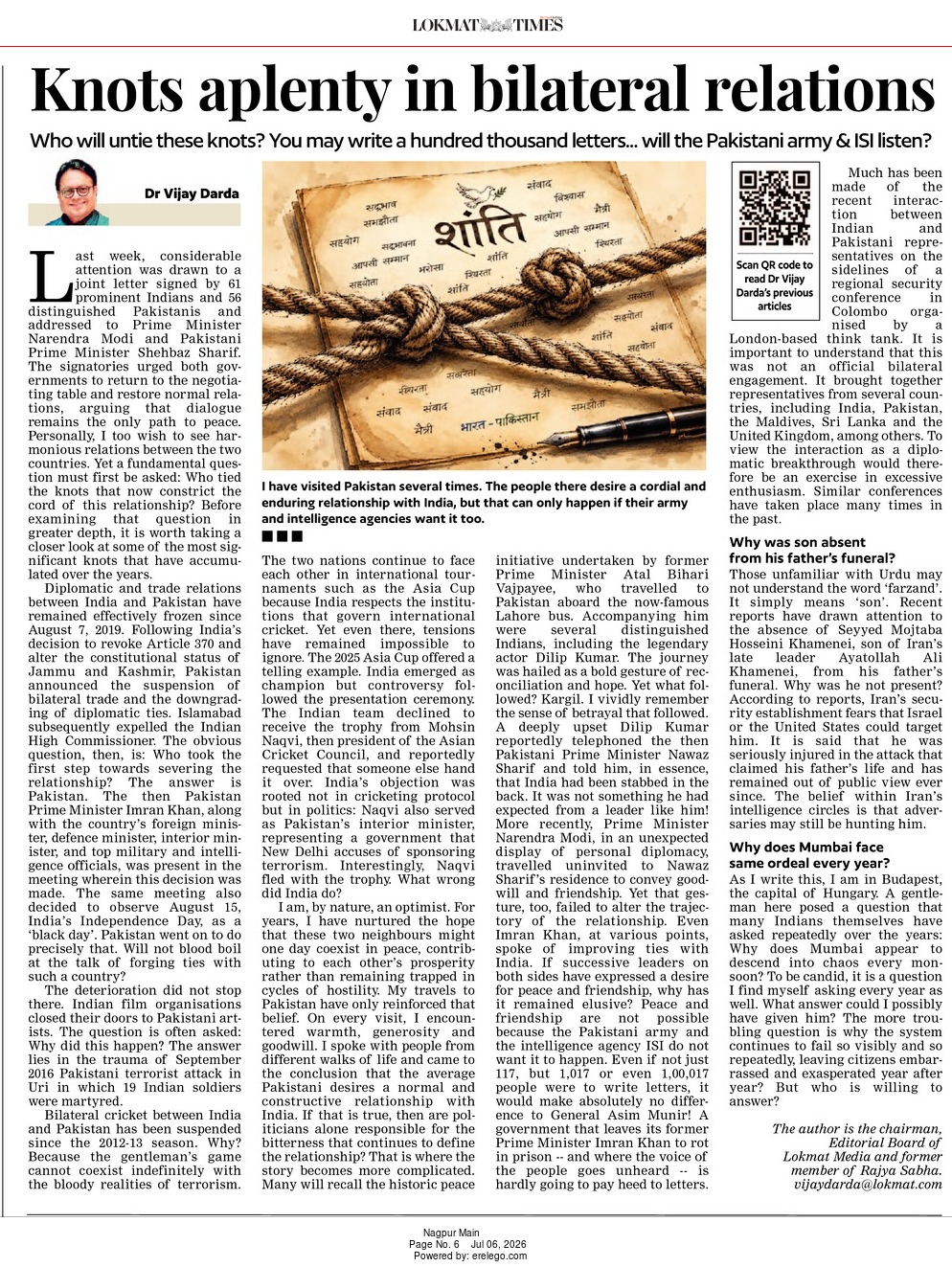
Last week, considerable attention was drawn to a joint letter signed by 61 prominent Indians and 56 distinguished Pakistanis and addressed to Prime Minister Narendra Modi and Pakistani Prime Minister Shehbaz Sharif. The signatories urged both governments to return to the negotiating table and restore normal relations, arguing that dialogue remains the only path to peace. Personally, I too wish to see harmonious relations between the two countries. Yet a fundamental question must first be asked: Who tied the knots that now constrict the cord of this relationship? Before examining that question in greater depth, it is worth taking a closer look at some of the most significant knots that have accumulated over the years.
Diplomatic and trade relations between India and Pakistan have remained effectively frozen since August 7, 2019. Following India’s decision to revoke Article 370 and alter the constitutional status of Jammu and Kashmir, Pakistan announced the suspension of bilateral trade and the downgrading of diplomatic ties. Islamabad subsequently expelled the Indian High Commissioner. The obvious question, then, is: Who took the first step towards severing the relationship? The answer is Pakistan. The then Pakistan Prime Minister Imran Khan, along with the country’s foreign minister, defence minister, interior minister, and top military and intelligence officials, was present in the meeting wherein this decision was made. The same meeting also decided to observe August 15, India’s Independence Day, as a ‘black day’. Pakistan went on to do precisely that. Will not blood boil at the talk of forging ties with such a country?
The deterioration did not stop there. Indian film organisations closed their doors to Pakistani artists. The question is often asked: Why did this happen? The answer lies in the trauma of September 2016 Pakistani terrorist attack in Uri in which 19 Indian soldiers were martyred.
Bilateral cricket between India and Pakistan has been suspended since the 2012-13 season. Why? Because the gentleman’s game cannot coexist indefinitely with the bloody realities of terrorism. The two nations continue to face each other in international tournaments such as the Asia Cup because India respects the institutions that govern international cricket. Yet even there, tensions have remained impossible to ignore. The 2025 Asia Cup offered a telling example. India emerged as champion but controversy followed the presentation ceremony. The Indian team declined to receive the trophy from Mohsin Naqvi, then president of the Asian Cricket Council, and reportedly requested that someone else hand it over. India’s objection was rooted not in cricketing protocol but in politics: Naqvi also served as Pakistan’s interior minister, representing a government that New Delhi accuses of sponsoring terrorism. Interestingly, Naqvi fled with the trophy. What wrong did India do?
I am, by nature, an optimist. For years, I have nurtured the hope that these two neighbours might one day coexist in peace, contributing to each other’s prosperity rather than remaining trapped in cycles of hostility. My travels to Pakistan have only reinforced that belief. On every visit, I encountered warmth, generosity and goodwill. I spoke with people from different walks of life and came to the conclusion that the average Pakistani desires a normal and constructive relationship with India. If that is true, then are politicians alone responsible for the bitterness that continues to define the relationship? That is where the story becomes more complicated. Many will recall the historic peace initiative undertaken by former Prime Minister Atal Bihari Vajpayee, who travelled to Pakistan aboard the now-famous Lahore bus. Accompanying him were several distinguished Indians, including the legendary actor Dilip Kumar. The journey was hailed as a bold gesture of reconciliation and hope. Yet what followed? Kargil. I vividly remember the sense of betrayal that followed. A deeply upset Dilip Kumar reportedly telephoned the then Pakistani Prime Minister Nawaz Sharif and told him, in essence, that India had been stabbed in the back. It was not something he had expected from a leader like him! More recently, Prime Minister Narendra Modi, in an unexpected display of personal diplomacy, travelled uninvited to Nawaz Sharif’s residence to convey goodwill and friendship. Yet that gesture, too, failed to alter the trajectory of the relationship. Even Imran Khan, at various points, spoke of improving ties with India. If successive leaders on both sides have expressed a desire for peace and friendship, why has it remained elusive? Peace and friendship are not possible because the Pakistani army and the intelligence agency ISI do not want it to happen. Even if not just 117, but 1,017 or even 1,00,017 people were to write letters, it would make absolutely no difference to General Asim Munir! A government that leaves its former Prime Minister Imran Khan to rot in prison — and where the voice of the people goes unheard — is hardly going to pay heed to letters.
Much has been made of the recent interaction between Indian and Pakistani representatives on the sidelines of a regional security conference in Colombo organised by a London-based think tank. It is important to understand that this was not an official bilateral engagement. It brought together representatives from several countries, including India, Pakistan, the Maldives, Sri Lanka and the United Kingdom, among others. To view the interaction as a diplomatic breakthrough would therefore be an exercise in excessive enthusiasm. Similar conferences have taken place many times in the past.
Why was son absent from his father’s funeral?
Those unfamiliar with Urdu may not understand the word ‘farzand’. It simply means ‘son’. Recent reports have drawn attention to the absence of Seyyed Mojtaba Hosseini Khamenei, son of Iran’s late leader Ayatollah Ali Khamenei, from his father’s funeral. Why was he not present? According to reports, Iran’s security establishment fears that Israel or the United States could target him. It is said that he was seriously injured in the attack that claimed his father’s life and has remained out of public view ever since. The belief within Iran’s intelligence circles is that adversaries may still be hunting him.
Why does Mumbai face same ordeal every year?
As I write this, I am in Budapest, the capital of Hungary. A gentleman here posed a question that many Indians themselves have asked repeatedly over the years: Why does Mumbai appear to descend into chaos every monsoon? To be candid, it is a question I find myself asking every year as well. What answer could I possibly have given him? The more troubling question is why the system continues to fail so visibly and so repeatedly, leaving citizens embarrassed and exasperated year after year? But who is willing to answer?
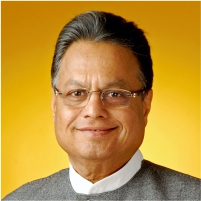
The author is the chairman, Editorial Board of Lokmat Media and former member of Rajya Sabha.
vijaydarda@lokmat.com
Intro
I have visited Pakistan several times. The people there desire a cordial and enduring relationship with India, but that can only happen if their army and intelligence agencies want it too.