 Media Coverage | 23-10-2026
News of Sheikh Hasina’s arrival has breathed new life into banned Awami League, leaving Jamaat-e-Islami stunned!
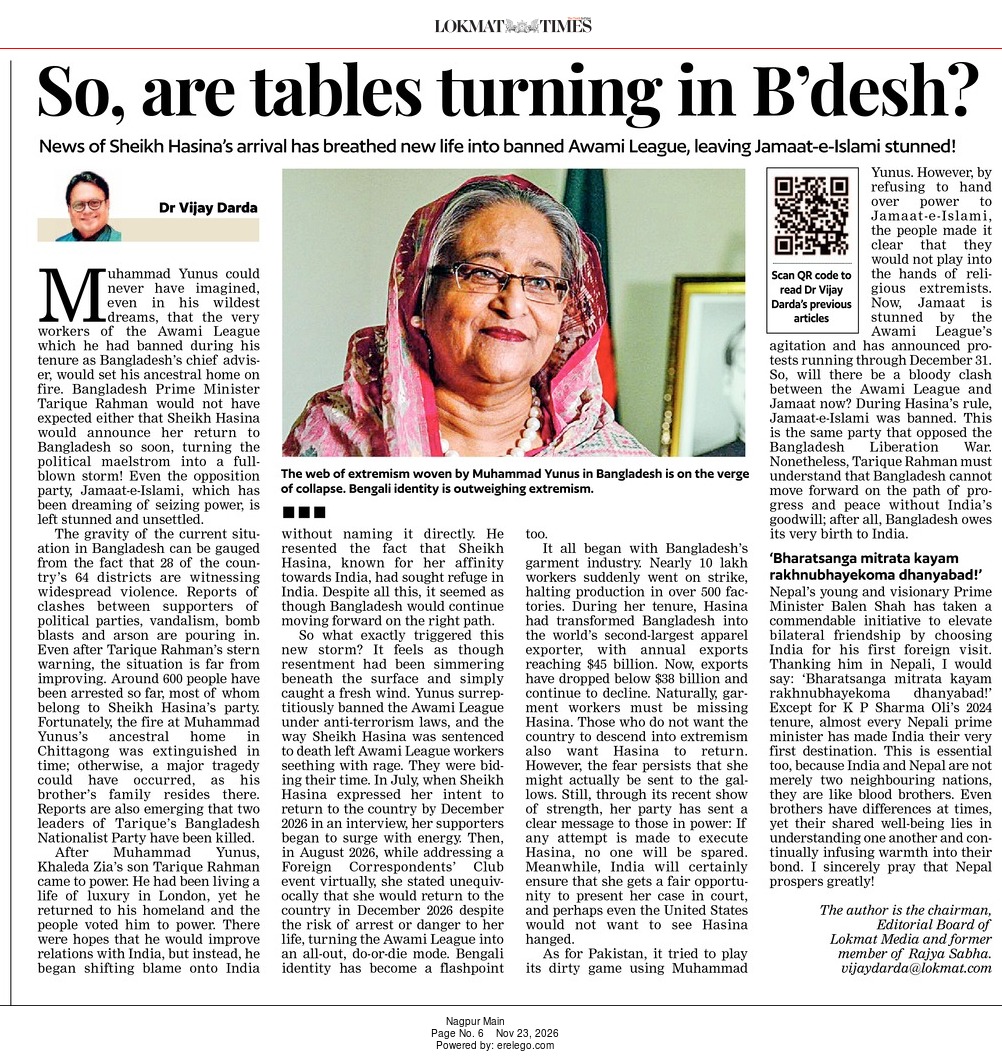
Muhammad Yunus could never have imagined, even in his wildest dreams, that the very workers of the Awami League which he had banned during his tenure as Bangladesh’s chief adviser, would set his ancestral home on fire. Bangladesh Prime Minister Tarique Rahman would not have expected either that Sheikh Hasina would announce her return to Bangladesh so soon, turning the political maelstrom into a full-blown storm! Even the opposition party, Jamaat-e-Islami, which has been dreaming of seizing power, is left stunned and unsettled.
The gravity of the current situation in Bangladesh can be gauged from the fact that 28 of the country’s 64 districts are witnessing widespread violence. Reports of clashes between supporters of political parties, vandalism, bomb blasts and arson are pouring in. Even after Tarique Rahman’s stern warning, the situation is far from improving. Around 600 people have been arrested so far, most of whom belong to Sheikh Hasina’s party. Fortunately, the fire at Muhammad Yunus’s ancestral home in Chittagong was extinguished in time; otherwise, a major tragedy could have occurred, as his brother’s family resides there. Reports are also emerging that two leaders of Tarique’s Bangladesh Nationalist Party have been killed.
After Muhammad Yunus, Khaleda Zia’s son Tarique Rahman came to power. He had been living a life of luxury in London, yet he returned to his homeland and the people voted him to power. There were hopes that he would improve relations with India, but instead, he began shifting blame onto India without naming it directly. He resented the fact that Sheikh Hasina, known for her affinity towards India, had sought refuge in India. Despite all this, it seemed as though Bangladesh would continue moving forward on the right path.
So what exactly triggered this new storm? It feels as though resentment had been simmering beneath the surface and simply caught a fresh wind. Yunus surreptitiously banned the Awami League under anti-terrorism laws, and the way Sheikh Hasina was sentenced to death left Awami League workers seething with rage. They were biding their time. In July, when Sheikh Hasina expressed her intent to return to the country by December 2026 in an interview, her supporters began to surge with energy. Then, in August 2026, while addressing a Foreign Correspondents’ Club event virtually, she stated unequivocally that she would return to the country in December 2026 despite the risk of arrest or danger to her life, turning the Awami League into an all-out, do-or-die mode. Bengali identity has become a flashpoint too.
It all began with Bangladesh’s garment industry. Nearly 10 lakh workers suddenly went on strike, halting production in over 500 factories. During her tenure, Hasina had transformed Bangladesh into the world’s second-largest apparel exporter, with annual exports reaching $45 billion. Now, exports have dropped below $38 billion and continue to decline. Naturally, garment workers must be missing Hasina. Those who do not want the country to descend into extremism also want Hasina to return. However, the fear persists that she might actually be sent to the gallows. Still, through its recent show of strength, her party has sent a clear message to those in power: If any attempt is made to execute Hasina, no one will be spared. Meanwhile, India will certainly ensure that she gets a fair opportunity to present her case in court, and perhaps even the United States would not want to see Hasina hanged.
As for Pakistan, it tried to play its dirty game using Muhammad Yunus. However, by refusing to hand over power to Jamaat-e-Islami, the people made it clear that they would not play into the hands of religious extremists. Now, Jamaat is stunned by the Awami League’s agitation and has announced protests running through December 31. So, will there be a bloody clash between the Awami League and Jamaat now? During Hasina’s rule, Jamaat-e-Islami was banned. This is the same party that opposed the Bangladesh Liberation War. Nonetheless, Tarique Rahman must understand that Bangladesh cannot move forward on the path of progress and peace without India’s goodwill; after all, Bangladesh owes its very birth to India.
‘Bharatsanga mitrata kayam rakhnubhayekoma dhanyabad!’
Nepal’s young and visionary Prime Minister Balen Shah has taken a commendable initiative to elevate bilateral friendship by choosing India for his first foreign visit. Thanking him in Nepali, I would say: ‘Bharatsanga mitrata kayam rakhnubhayekoma dhanyabad!’ Except for K P Sharma Oli’s 2024 tenure, almost every Nepali prime minister has made India their very first destination. This is essential too, because India and Nepal are not merely two neighbouring nations, they are like blood brothers. Even brothers have differences at times, yet their shared well-being lies in understanding one another and continually infusing warmth into their bond. I sincerely pray that Nepal prospers greatly!
The author is the chairman, Editorial Board of Lokmat Media and former member of Rajya Sabha.
vijaydarda@lokmat.com